
Currently Empty: ₹0.00
Top 10 Mistakes Students Make in DGCA Exam Preparation (and How to Avoid Them)
December 23, 2025
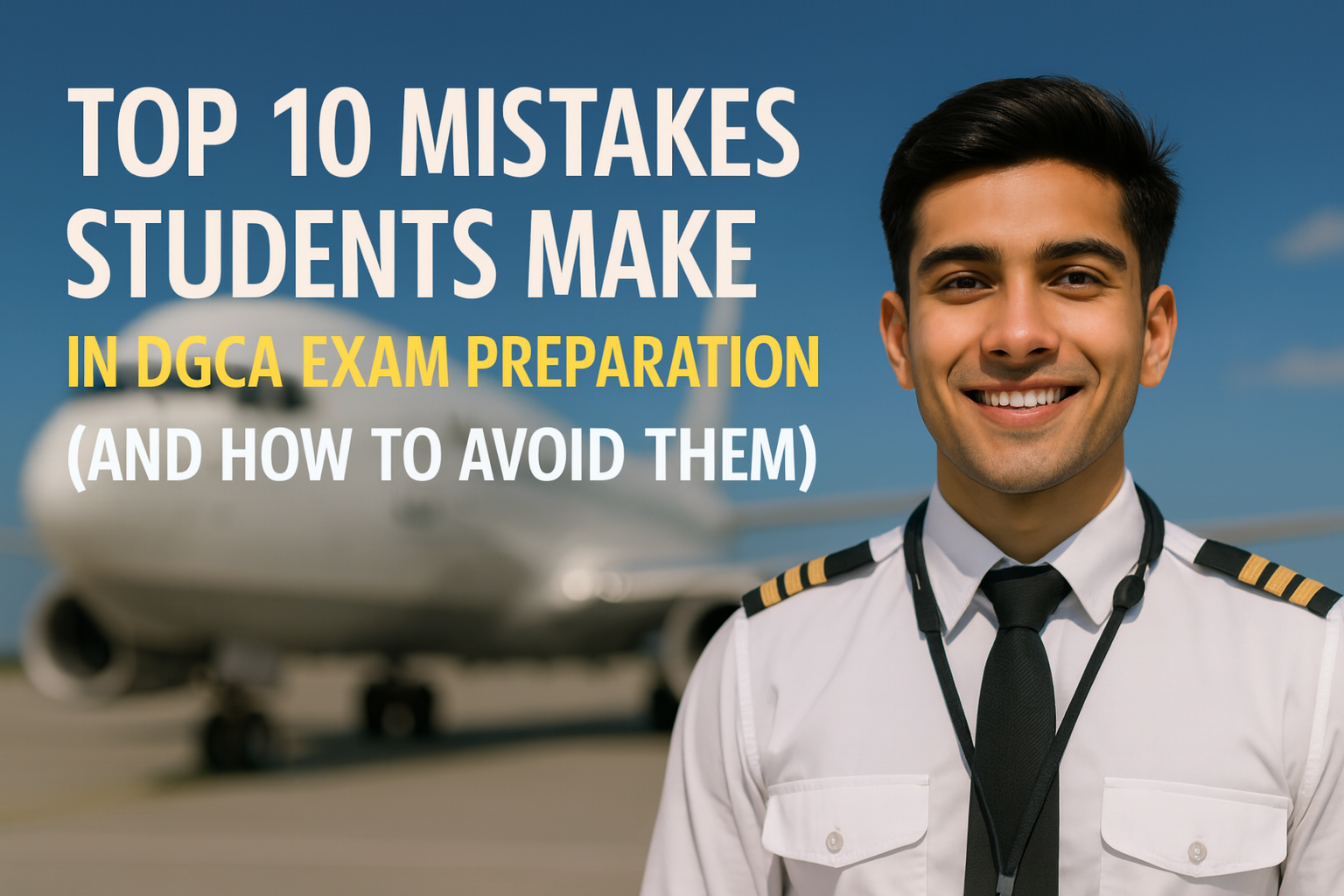
Becoming a pilot in India is one of the most rewarding career choices, but the path to the flight deck is paved with rigorous theoretical examinations. The DGCA ground exams are notoriously challenging, with a 70% passing requirement that leaves zero room for half-hearted preparation.
Whether you are studying at a premier aviation academy or independently, your success depends on strategy as much as effort. To help you clear your papers on the first attempt, we’ve outlined the top 10 common mistakes students make—and how to avoid them.
1. Relying Solely on Question Banks
This is perhaps the most dangerous trap. Many students believe that memorizing 2,000 questions from an app will guarantee a pass. While question banks are excellent for practice, the DGCA is known for subtly changing the wording or values in a question to test true understanding.
- How to Avoid: Treat question banks as a diagnostic tool, not a primary source. Ensure you attend structured dgca ground classes to build a foundation of the “why” behind every answer.
2. Ignoring Conceptual Clarity in Navigation
Air Navigation is the hurdle that stops many aspiring pilots. It involves spherical geometry, complex time conversions, and wind triangle calculations. Rote learning formulas without understanding the spatial relationship will lead to failure when faced with an unfamiliar scenario.
- How to Avoid: Use visual aids and physical models to understand concepts like Latitude/Longitude and Great Circles.
3. Underestimating Aviation Meteorology
Students often view “Met” as just weather talk, but it is deeply scientific. From interpreting Tephigrams to understanding Jet Streams and Frontal Systems, it requires precision.
- How to Avoid: Don’t just read about weather; look at it. Practice decoding METAR and TAF reports daily. If you struggle with the physics of the atmosphere, seek an aviation academy that offers specialized meteorology modules.
4. Not Mastering the Flight Computer (CX-3 or E6B)
On the day of the Air Navigation exam, your flight computer is your best friend—but only if you know how to use it. Many students wait until the last week to learn the functions, leading to slow calculations and “exam panic” when the clock starts ticking.
- How to Avoid: Make the flight computer an extension of your hand. Use it for every practice session until you can calculate wind correction angles and fuel burn in seconds.
5. Neglecting the “Easiest” Subjects
Subjects like Air Regulations or Human Performance and Limitations (HPL) are often pushed to the final few days because they seem “easy.” However, the DGCA has recently increased the technicality of these papers.
- How to Avoid: Give every subject the respect it deserves. Air Regulations, in particular, requires multiple revisions to keep the specific heights, speeds, and legalities fresh in your mind.
6. Studying from Outdated Materials
Aviation is a dynamic industry. Rules change, airspaces are reclassified, and DGCA patterns evolve. Using notes from three years ago is a recipe for disaster.
- How to Avoid: Always cross-reference your notes with the official DGCA Civil Aviation Requirements (CARs). Reputable dgca ground classes will always provide the most current, updated syllabus materials.
7. Poor Time Management During Prep
Many students spend three months on one subject and only two weeks on the others. This imbalance leads to burnout in the final stretch.
- How to Avoid: Create a structured timetable. A balanced approach—spending 40% of your time on your weakest subject and 20% on constant revision of cleared topics—is the most effective strategy.
8. The “60s Trap”
In the DGCA world, a score of 62% or 68% is a “failure,” yet many students treat it as an “almost pass.” They then make the mistake of only revising their weak areas for the next attempt.
- How to Avoid: If you score in the 60s, don’t just revise—relearn. Re-enroll in a module at your aviation academy and treat the subject as if you are seeing it for the first time. There are fundamental gaps in your knowledge that need to be filled.
9. Lack of Full-Length Mock Exams
Solving 10 questions at a time is easy. Sitting for 2–3 hours and solving 50–100 questions under pressure is a different ballgame. Students who skip timed mock exams often struggle with fatigue and “silly mistakes” during the actual test.
- How to Avoid: In the two weeks leading up to your exam, take at least five full-length, timed mock tests. This builds the mental stamina required for the CBT (Computer Based Training) format.
10. Neglecting Communication (RTR Prep)
Radio Telephony (RTR) is as much about confidence as it is about knowledge. Many students focus so much on the written papers that they neglect the vocal and procedural practice required for the RTR(A) exam.
- How to Avoid: Practice your “calls” out loud. Record yourself and listen back to check for clarity and phraseology. Peer-to-peer practice in a classroom setting is often the best way to overcome “mic-fright.”
Comparison: Why a Structured Approach Wins
| Factor | Self-Study Pitfalls | Structured Ground Classes |
| Material | Often scattered or outdated | Curated, updated, and exam-focused |
| Doubts | Hard to clarify technical concepts | Instant access to experienced instructors |
| Pace | Easy to procrastinate | Disciplined, scheduled learning |
| Success Rate | Depends on extreme self-discipline | High, due to structured mock testing |
Final Thoughts
Clearing your DGCA exams is not about being the smartest person in the room—it’s about being the most prepared. By avoiding these ten common mistakes and choosing the right guidance through professional DGCA ground classes, you ensure that your transition from the classroom to the cockpit is as smooth as a greased landing.