Currently Empty: ₹0.00
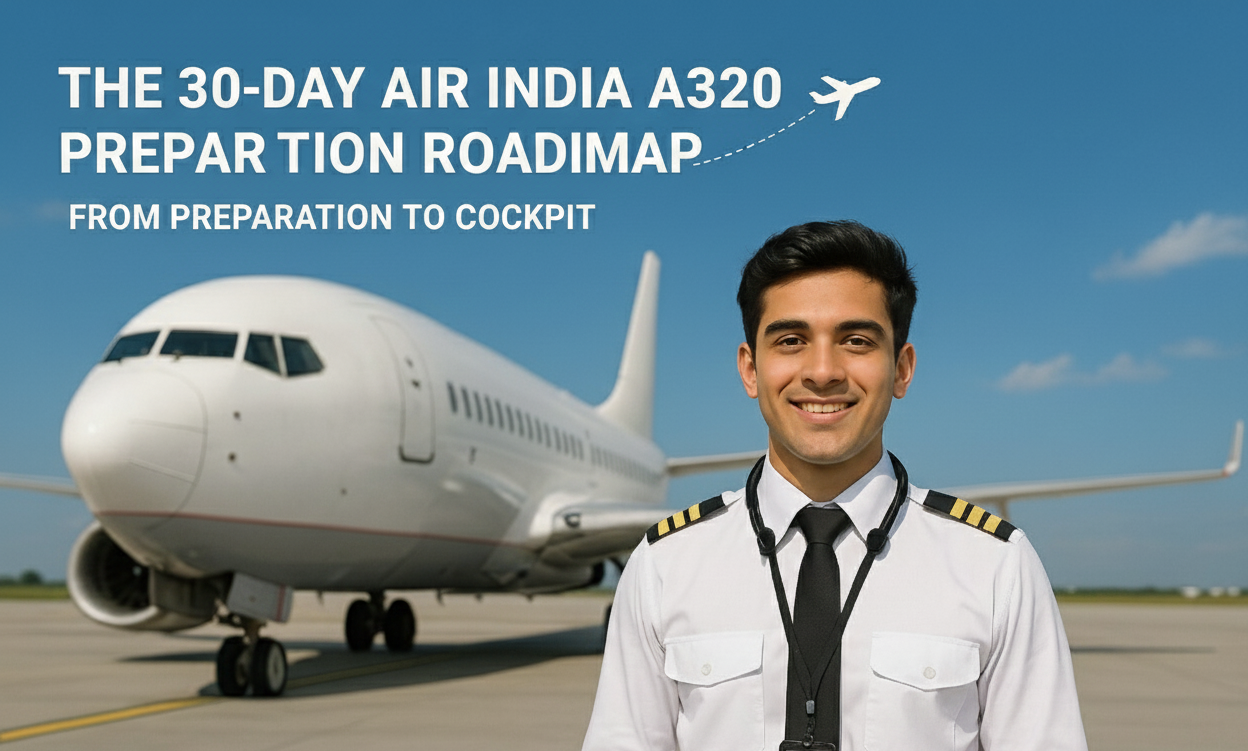
Becoming an Airbus A320 pilot for Air India is a dream many Indian aviators chase—but few prepare for it strategically. The selection process is demanding, the aircraft is technologically advanced, and expectations from pilots are high from day one. What separates successful candidates from the rest is not just flying hours, but focused, high-quality preparation.
This blog presents a 30-day practical preparation roadmap designed specifically for aspirants targeting Air India’s Airbus A320 online training fleet. Whether you’re transitioning from another aircraft or preparing as a fresh type-rated pilot, this guide walks you from ground preparation to cockpit readiness—step by step.
Why the Airbus A320 Demands Structured Preparation
The Airbus A320 is a fly-by-wire aircraft that relies heavily on automation, system logic, and crew coordination. Air India, operating in complex Indian airspace and diverse weather conditions, expects pilots to demonstrate:
- Strong systems understanding: Moving beyond “buttons” to “logic.”
- SOP discipline: Following the standard operating procedures of a legacy carrier.
- Situational awareness: Navigating the unique challenges of the Indian subcontinent.
- Decision-making under pressure: Managing emergencies with a calm, analytical mind.
Cramming a few days before an assessment rarely works. A 30-day roadmap allows your knowledge, confidence, and muscle memory to build gradually—just like real-world flying.
Week 1: Manuals, Foundations & Aircraft General
The first week is about getting comfortable with the Study Material. You must transition from casual reading to professional study using the FCOM (Flight Crew Operating Manual) and FCTM (Flight Crew Training Manual).
- Days 1–3: The Core Manuals: Focus on General Manuals and Aircraft General. Understand the dimensions, cockpit layout, and the “Airbus Philosophy.”
- Days 4–5: Environmental Systems: Dive into Air Conditioning, Pressurization, Ventilation, and Pneumatics. These are the “invisible” systems that are critical for passenger safety and aircraft health.
- Days 6–7: Support Systems: Cover the APU, Fire Protection, and Oxygen systems. Understand the logic of the fire loops and the automatic activation of oxygen masks.
Week 2: Mechanical Mastery & Systems Logic
This week moves into the “heavy” systems. Examiners frequently use these topics to test your depth of knowledge.
- Days 8–10: The Powerhouse: Study Engines and Fuel. Understand the FADEC logic and how the fuel system automatically manages the aircraft’s center of gravity.
- Days 11–12: Hydraulics & Landing Gear: Learn the Green, Blue, and Yellow system priorities and what happens during a gravity gear extension.
- Days 13–14: Flight Controls: Master the “Fly-By-Wire” logic. Study Flight Controls (Normal, Alternate, and Direct Law) and how Ice & Rain protection systems impact performance.
Week 3: Automation, Avionics & CPL Refresh
As you move into the second half of the month, the focus shifts toward the electronic “brain” of the aircraft and refreshing your CPL Preparation fundamentals.
- Days 15–17: The Electronic Cockpit: Focus on Electrical, Navigation, Surveillance, and Communication systems. This is where Airbus A320 online training tools are most effective for visualizing signal flows.
- Days 18–19: Auto Flight & Indications: Master the Auto Flight system (FMGS) and Indication & Recording (ECAM/EFIS). Understand how to read the FMA (Flight Mode Annunciator) like a second language.
- Days 20–21: Performance & Equations: Revisit General Performance and Aircraft Performance. Be ready to discuss Equations and Limitations regarding climb gradients and runway requirements.
Week 4: The “Crash Course” & Final Polish
The final week is about “Pilot Thinking.” This phase is often referred to as an A320 Air India Crash Course because it condenses real-world operational thinking into focused daily practice.
- Days 22–24: Targeted Practice: Shift to Practice mode. Use Cheat Sheets for quick recall and focus on Recent Trends in Air India’s interview patterns.
- Days 25–27: Mock Tests: Conduct full-length Mock Tests to simulate the pressure of the written and technical viva rounds. Focus on Key Facts and structural Limitations.
- Days 28–30: Revision & CRM: Final Revision. Practice your “STAR” method responses for HR questions. Air India looks for communication clarity, leadership with humility, and a safety-first attitude.
Common Mistakes Aspirants Make
- Studying systems without understanding logic (rote learning).
- Ignoring the FCTM, which explains how to fly, not just what the systems are.
- Over-dependence on unofficial notes instead of the FCOM.
- Neglecting CPL Preparation basics like meteorology and air regulations.
Final Thoughts: From Preparation to Cockpit
The journey to the Air India A320 cockpit is not about shortcuts—it’s about structured discipline. A 30-day roadmap helps transform scattered knowledge into confident execution.
Think like a line pilot. Prepare like a professional. Fly like safety depends on it—because it does.
FAQs
Q: What are the educational requirements for Air India A320 pilots?
A: Candidates must have passed 10+2 with Physics and Mathematics. A valid DGCA-issued CPL, FRTO, and RTR are mandatory.
Q: Do I need a Type Rating before applying to Air India?
A: While Air India often recruits “Transition Pilots” (non-rated), having an A320 Type Rating and completing Airbus A320 online training significantly enhances your candidacy for direct-entry roles.
Q: What is the most important part of the simulator assessment?
A: Beyond manual flying skills, Air India evaluates your “trainability” and CRM. They want to see how you handle “Automation surprises” and whether you maintain SOP discipline under stress.
Q: What are the medical requirements for the Air India A320 fleet?
A: A candidate must hold a valid DGCA Class 1 Medical Assessment. Any “Limitations” on the medical (like corrective lenses) must be declared and within the airline’s policy.
Q: What are the basic requirements to join Air India as an A320 pilot?
A: Candidates typically require a valid DGCA CPL or ATPL, A320 type rating, current medical, and applicable flying hours as per the vacancy notice.
Q: Is an A320 type rating mandatory for Air India?
A: Yes, most Air India A320 pilot recruitments require a valid and current A320 type rating.
Q: How difficult is the Air India A320 simulator assessment?
A: The assessment focuses on basic flying skills, automation management, SOP awareness, and decision-making—not extreme handling skills.
Q: Does Air India prefer experienced A320 pilots or fresh type-rated pilots?
A: Air India recruits both, depending on operational demand. However, preparation quality often matters more than total hours.
Q: How long should I prepare before an Air India A320 interview?
A: A focused 30-day preparation plan is considered ideal for most candidates.