
Currently Empty: ₹0.00

Cracking the Indigo GD & PI is often viewed as a high-stakes hurdle that depends on luck. However, for the smart candidates—those who treat the selection process like a flight mission—success is a result of preparation and “insider” strategy. With IndiGo’s massive expansion in 2026 and stricter DGCA norms, the airline isn’t just looking for pilots; they are looking for “line-ready” professionals with high emotional intelligence.
In this guide, we reveal the blueprint used by top performers in airline group discussion classes to gain an unfair advantage before the examiner even opens their mouth.
How GD Groups Are Actually Formed
The biggest mistake candidates make is walking into the waiting area and sitting in a corner, their phone in hand. Smart candidates know that the GD doesn’t start in the conference room; it starts the moment you receive your assessment email.
Understanding Role Numbers & Batch System
When you pay your assessment for the ADAPT/GD rounds, you receive a PDF confirmation. On that document is a “Letter Number” or “Assessment ID”—for example, Indigo/0456.
Most students think this is a random serial number. It isn’t. This number represents your place in the Indigo selection process merit list for that specific drive.
The “Multiple of 6” Group Formation Strategy
IndiGo typically calls 36 candidates per session, divided into 6 groups of 6 people each. The groups are almost always formed in sequential order of these assessment IDs.
- Group 1: Candidates with IDs 001–006
- Group 2: Candidates with IDs 007–012
By identifying the five people with numbers immediately above or below yours, you are essentially looking at your future crew members.
Predicting Your GD Group Before Announcement
Once you are in the waiting area (whether at VWork or CIE), don’t just wait. Start asking others, “Hey, what was your assessment ID number?” Within 10 minutes, you can identify your entire group. This “merit list hack” allows you to turn a group of strangers into a coordinated team before the panel calls your name.
| Feature | Unprepared Candidate | Smart Candidate |
| Peer Interaction | Silent and nervous | Identifies group via ID numbers |
| Strategy | Reactive (waits for topic) | Proactive (assigns roles early) |
| Mindset | Competitive (me vs. them) | Collaborative (CRM-focused) |
Pre-GD Strategy: The Game-Changing Hack
The secret to how to crack Indigo GD isn’t just about speaking better English; it’s about Crew Resource Management (CRM). The airline wants to see if you can work with people you’ve just met.
Building Rapport Before GD
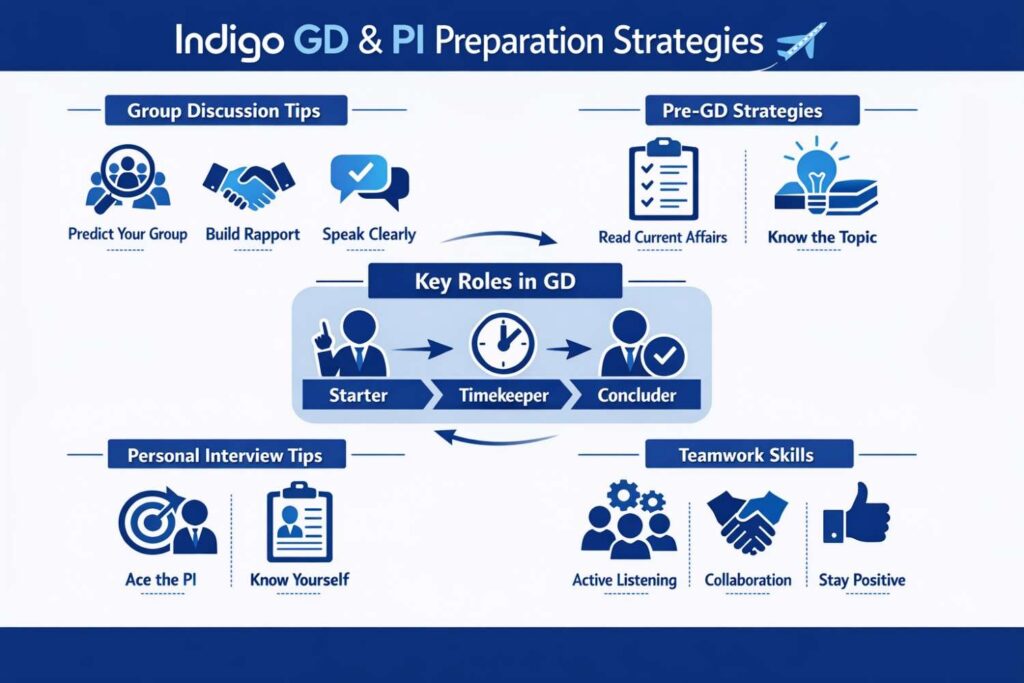
Once you’ve identified your group of six, move to a corner and “break the ice.” Introduce yourself, discuss your CPL training, and help everyone get comfortable. If you find a particularly nervous candidate, encourage them. The panel often watches the waiting area—inclusive behaviour here is a massive green flag.
Deciding Roles (Starter, Timekeeper, Concluder)
Use the waiting time to pre-assign tasks. This isn’t “cheating”; it’s professional coordination.
- The Starter: The most confident speaker who opens the topic.
- The Timekeeper: Ensures the group finishes within the 15-minute window.
- The Concluder: Summarises the group’s consensus.
When the group enters the room with a plan, the “fish market” (everyone shouting) is eliminated, and the entire group’s pass rate skyrockets.
Why Friendly Candidates Perform Better
Aviation is a social career. You fly with different captains and crews every day. If you are seen as an “outgoing personality” who can build rapport in 15 minutes, the HR panel knows you will fit into the IndiGo culture seamlessly.
GD Performance Strategy: Winning the Room
The actual discussion is where your communication skills for GD & PI are put to the test.
First Impression Rules (Entry, Smile, Etiquette)
- The Door Etiquette: If you are first, hold the door for others. If you are last, close it quietly.
- The Smile: Enter with a genuine smile. It signals “low stress, high capacity.”
- The Greeting: Check the clock. 12:00 PM to 4:00 PM is “Good Afternoon.” Messing this up shows poor situational awareness.
Speaking in the First 3 Minutes
The “Golden Rule” taught in premium Airline HR & Mock Personal Interview Classes is to speak within the first 3 minutes. If you wait until the end, the best points are taken, and you look passive. You don’t need to lead; you just need to contribute a logical, structured point early to “get into the game.”
Handling Dominating Candidates
If a candidate is shouting or not letting others speak, do not fight them. Instead, use a “Bridge Statement”:
“I hear your point, and it’s valid. However, in the interest of the team, let’s hear what as to think about this.”
This shows the panel you have leadership without being dominant—a key trait of a future First Officer.
What the Panel Observes in GD
The Indigo panel usually consists of a Pilot (Technical) and an HR/Psychologist. They aren’t just listening to your facts; they are analysing your DNA as a team player.
- Teamwork & CRM Skills: Do you use your peers’ names? Do you look at everyone, or just the panel? (Tip: Never look at the panel during the GD; look at your group.
- Communication & Listening Skills: Aviation English is about clarity, not flowery vocabulary. Can you listen to a counter-argument without getting defensive?
- Leadership Without Dominance: Can you guide the group back to the topic if they deviate? This shows you can handle a cockpit environment where the “plan” might change.
Personal Interview (PI) Winning Strategy
If you pass the GD, you move to the Personal Interview. This is where they verify if the person they saw in the GD is the “real you.”
Confidence & Clarity
The PI focuses on your background, your “Why Indigo?” and your technical journey. Be ready for situational interview questions Indigo is famous for, such as “What would you do if your Captain was ignoring a checklist?” Situational Awareness (Etiquettes Matter)
The interview starts the moment you walk from the door to the chair. Your posture, how you place your file, and your eye contact with both interviewers (not just the one asking the question) are all evaluated.
Real-Life Personality Evaluation
Indigo prefers candidates who are humble yet confident. Use the “STAR” method (Situation, Task, Action, Result) to answer questions about your life. This provides the structure that pilots are expected to have.
Conclusion & Next Steps
Cracking the Indigo GD & PI is about 30% knowledge and 70% strategy. By predicting your group, building rapport early, and demonstrating “CRM on the ground,” you prove to the airline that you are already thinking like a Captain.
Ready to ace your selection?
- Join our next Webinar: Get the latest 2026 fleet updates and “merit list hacks” live.
- Enroll in our Mock GD Sessions: Practice with real-world Indigo topics and get feedback from industry experts.
- Check out our Type Rating Courses: Be line-ready before the airline even hires you!
Click Here to Join the Next Aviation Webinar: How to Crack Airline PI – What Interviewers Actually Look For?
Frequently Asked Questions (FAQ)
Q1: What are the common Indigo Group Discussion topics for 2026?
A: Current topics often revolve around AI in aviation, the impact of new airports like Noida/Jewar on the Indian economy, and “Modern Technology vs. Traditional Pilot Skills.”
Q2: How much is the Indigo ADAPT and GD fee?
A: As per the current 2026 cycles, the fee is approximately 38,000 INR, which covers the online assessment and subsequent offline rounds.
Q3: Can I reapply if I fail the Indigo PI?
A: Yes, but there is typically a “cooling-off” period of 3 to 6 months, depending on the specific cadet or JFO program guidelines.
Q4: How do I prepare for the Indigo Personal Interview?
A: Focus on your CPL knowledge, current aviation affairs (like Indigo’s A321XLR deliveries), and practice mock interviews to refine your body language and tone.