Currently Empty: ₹0.00

The Indian aviation sector is currently undergoing a massive transformation. With Air India’s historic fleet expansion—involving hundreds of new Boeing and Airbus aircraft—the demand for high-quality, airline-trained pilots has never been higher.
The Air India Cadet Pilot Program is designed to take you from a civilian with a dream to a cockpit-ready First Officer. Unlike traditional pilot training, where you navigate the DGCA process in isolation, the cadet program offers a streamlined, airline-monitored pathway. If you are ready to earn your wings with the flag carrier, here is your definitive guide to applying in 2026.
Understanding the Cadet Pilot Pathway
The Air India Cadet Pilot Program is not just a flight school; it is an integrated training scheme sponsored by the airline. You are selected based on your potential, aptitude, and personality fit before you ever touch a flight control.
Why Aspiring Pilots Choose This Path:
- Guaranteed Career Path: Successful completion comes with a Letter of Intent (LOI) for employment as a Trainee Pilot with Air India.
- Airline-Aligned Standards: From day one, you are trained to follow Air India’s specific Standard Operating Procedures (SOPs).
- Structured Progression: The program covers everything: Ground school, flying hours, license conversion, and finally, the aircraft-specific Type Rating.
Eligibility Criteria for 2026
Before you begin your application, ensure you meet the strict criteria. Air India maintains high standards to ensure only the most dedicated candidates progress to the training phase.
- Age: You must be between 18 and 30 years old on the date of application.
- Educational Qualification: 10+2 (or equivalent/NIOS) with at least 60% marks individually in Physics, Mathematics, and English.
- Nationality: You must be an Indian citizen or an Overseas Citizen of India (OCI) cardholder.
- Medical Fitness: You must be able to obtain a DGCA Class 1 Medical Certificate.
- English Proficiency: As an international airline, Air India requires candidates to have a high level of written and spoken English proficiency.
Step-by-Step Application Process
The application process is handled through the official Air India Cadet Pilot portal. Do not use third-party links for your initial application.
Phase 1: Online Application
Visit the Air India Cadet Pilot portal. Fill out the required details, upload your academic certificates, and confirm you meet the age and subject requirements. Double-check your contact details—this is how they will contact you for the next stages.
Phase 2: Pilot Aptitude Assessment
Once your application is screened and verified, you will be invited for an aptitude test. This is often a computer-based assessment (like ADAPT or similar platforms) designed to test:
- Spatial Awareness: Can you visualise aircraft movement?
- Numerical Reasoning: Can you perform quick mental math?
- Multitasking: Can you handle multiple inputs under time pressure?
Phase 3: Psychometric and Group Assessment
Airlines don’t just want good fliers; they want good people. The psychometric assessment evaluates your integrity, decision-making, and stress tolerance. In the group discussion, you will be observed on:
- Teamwork: How you include others.
- Communication: Your ability to articulate a safety-first mindset.
- Leadership: Your capacity to lead without dominating.
Phase 4: Technical & HR Interview
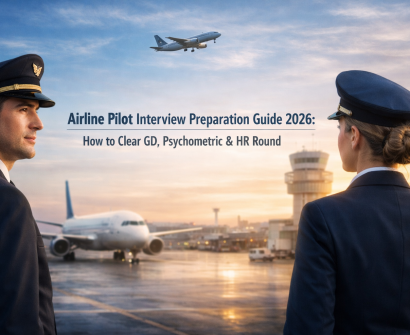
The final hurdle is the Airline pilot interview. Here, recruiters look for career clarity and basic aviation fundamentals. You may be asked about your motivation for joining Air India specifically, or how you would handle a disagreement with a Captain during a flight.
Preparing for Success: Tips for 2026 Candidates
Technical knowledge is crucial, but it won’t save you if you fail the soft-skills rounds.
- The “Pilot Voice”: In your Group Discussion, be calm, authoritative, and collaborative. Avoid the “Alpha Pilot” trap where candidates try to shout over others to prove leadership.
- Master the Psychometric: There are no “right” answers in psychometric testing, but there is “consistent” logic. Research the traits of a safe, disciplined pilot and focus on being honest rather than trying to “game” the test.
- Brush up on Basics: Even for a cadet program, know your basic aerodynamics, weather (meteorology) concepts, and current aviation trends.
Comparison: Cadet Pilot Program vs. Conventional CPL Route
| Feature | Cadet Pilot Program | Conventional CPL Route |
| Placement | Guaranteed (on completion) | Not guaranteed, requires searching |
| Training Structure | Airline-monitored & integrated | Independent flight school |
| Timeline | 18–24 Months (Structured) | Variable (18–36 months) |
| Selection | Competitive airline screening | Self-selected |
| Mentorship | Direct airline mentorship | Dependent on school instructors |
Conversion and Training Considerations
If your flight training takes place abroad (e.g., in the USA), remember that you will need to perform a license conversion. A DGCA license upon your return. The cadet program usually manages this process, but you will still be required to clear the DGCA Ground classes for DGCA exams Technical exams (Air Navigation, Meteorology, Air Regulations) to ensure your theoretical knowledge meets Indian standards.
Important Training Phases:
- Orientation: Understanding company culture.
- Ground School: Clearing your DGCA technical papers.
- Flight Training: Accumulating your 200 hours (Single and Multi-engine).
- Type Rating: Training on the specific aircraft (A320 or B737) at the aviation training academy.
Conclusion: Take the Leap
Applying for the Air India Cadet Pilot Program is the start of a professional journey that demands discipline and grit. By focusing on your core aptitude, maintaining a high standard of academic performance, and preparing effectively for the Airline pilot interview, you can position yourself as the exact type of candidate Air India is looking for in 2026.
Your Next Steps:
- Check Your Documents: Ensure your 10+2 marksheet meets the 60% requirement.
- Medical First: Do not start any long-term training until you have secured a valid DGCA Ground Classes 1 medical.
- Practice Aptitude: Spend at least an hour daily practising numerical and logical reasoning to sharpen your mental speed.
Q: Is a cadet program worth the high cost?
A: If your primary goal is a stable career with a legacy carrier and you want to avoid the uncertainty of independent job hunting, the cadet program is worth the investment. It essentially buys you a structured “fast lane” into the cockpit.
Q: Do I need a Type Rating before applying?
A: No. The Cadet Pilot Program is designed for candidates with zero flying experience. The type rating is provided by the airline after you finish your flight training.
Q: What happens if I fail an assessment?
A: Most airlines impose a “cooling-off period” of 3 to 6 months before you can reapply. Use this time to retrain and address the weaknesses identified in your assessment.
Q: How do I prepare for the ADAPT psychometric test?
A: Focus on software that simulates these tests. Practising numerical and spatial reasoning under timed conditions is the best way to reduce anxiety on the test day.