Currently Empty: ₹0.00
How to Pass the Air India Pilot Selection: A Step-by-Step Guide to Interview and Group Discussion
January 8, 2026
For the first time in recent history, technical knowledge alone won’t get you into Air India. The 2026 selection process has introduced a mandatory Group Discussion (GD) stage, designed to test Crew Resource Management (CRM) and English Language Proficiency (ELP) before you ever touch a simulator.
Air India wants to see how you resolve conflicts and handle “Safety vs. Commercial Viability” debates. Many brilliant pilots are being filtered out simply because they lack the “Pilot Voice” or dominate the conversation incorrectly. This blog explores the specific aviation topics being tested and the leadership qualities the Air India panel is looking for in 2026.
Mastering the Air India Group Discussion (GD) for Pilots
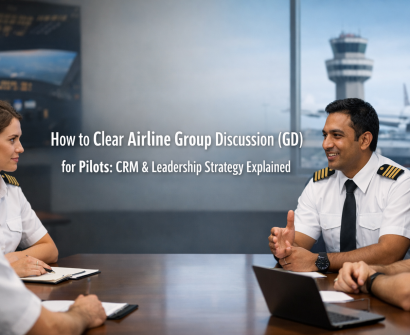
The Group Discussion is often the most misunderstood part of the Air India selection process. Candidates who are used to the solitary nature of DGCA ground classes often struggle when forced into a collaborative environment. In 2026, the GD is not a debate; it is a simulation of the cockpit environment.
The panel, typically consisting of a Senior Captain and an HR expert, observes how you interact with a group of 8 to 12 peers. They aren’t just listening to what you say, but how you say it.
Key Assessment Areas:
- English Language Proficiency (ELP): Your ability to communicate complex ideas clearly and without hesitation.
- Situational Awareness: Can you identify the “core” problem in a scenario quickly?
- Conflict Resolution: How do you react when someone disagrees with your safety assessment?
To stay ahead of the curve, many candidates are now looking into the system to understand exactly how the scoring rubrics have shifted this year.
Why Technical Skills Aren’t Enough Anymore
In the past, passing your technical papers and simulator check was a 90% guarantee of a job. However, the 2026 mandate focuses heavily on “The Human Factor.” Air India has realized that most incidents occur not because of mechanical failure, but because of a breakdown in communication.
If you have completed your Airbus A320 online training, you know the systems inside out. But in a GD, you might be asked: “Should a flight be delayed for a minor technical snag that is technically ‘Go’ under the MEL but makes passengers uncomfortable?” There is no “right” answer in the back of a textbook. The recruiters are looking for:
- Safety Mindset: Does your logic always prioritize the safety of the aircraft?
- Commercial Awareness: Do you understand the cost of a delay without compromising safety?
- Assertiveness: Can you speak up against a “Captain” figure in the group if they are making a risky choice?
This shift toward behavioral evaluation is closely tied to the “Pilot Mindset” discussed in our guide on psychometric testing.
Common Air India GD Topics: Automation, Safety, and Commercials
The topics provided in the 2026 intake have shifted away from general current affairs toward “Aviation Specific” dilemmas. You need to be prepared to discuss topics that bridge the gap between your A320 Air India Crash Course knowledge and real-world leadership.
Frequent 2026 GD Topics:
- Automation vs. Manual Flying: Is the increasing reliance on Flight Management Systems (FMS) eroding basic stick-and-rudder skills?
- The “Safety vs. On-Time Performance” (OTP) Dilemma: How much pressure should a pilot take from management to keep the schedule?
- Pilot Mental Health: Should there be a mandatory “No-Fly” period for pilots facing personal stress, even if they feel “fine”?
- Cockpit Hierarchy: Should a Junior First Officer be allowed to override a Captain’s decision in a non-emergency scenario?
The “Dominance vs. Silence” Trap
A common mistake in the Air India GD is the “Alpha Pilot” syndrome. Many candidates feel they must dominate the 15-minute window to show leadership. Conversely, others stay silent, hoping their high scores in technical rounds will save them. Both are traps.
How to avoid the trap:
- The Facilitator Role: If the group is stuck, be the person who summarizes the points and asks a quiet member for their opinion. This shows “Command Presence.”
- The Data-Driven Approach: Use your technical background. If the topic is fuel efficiency, mention specific Airbus operational stats.
- Active Listening: Acknowledge the previous speaker. Phrases like, “I agree with your point on fuel reserves, however, we must also consider…” are gold in the eyes of the assessors.
Live Mock GDs: The Secret to Building a “Pilot Voice”
You cannot “study” for a GD by reading a book. You need to hear yourself speak under pressure. This is where Live Mock GDs become essential.
The “Pilot Voice” is characterized by being calm, authoritative, but collaborative. It is the voice that reassures passengers over the PA and coordinates with ATC during an emergency.
Preparation Strategy:
- Join a Peer Group: Practice with other CPL holders.
- Record Yourself: Listen for “filler words” (um, ah, like). Pilots are expected to have high ELP scores.
- Timed Responses: Practice delivering a powerful point in under 45 seconds. In the real Air India GD, you may only get 3 or 4 chances to speak effectively.
Conclusion & Next Steps
Cracking the Air India selection process in 2026 requires a 360-degree approach. While your technical ratings provide the foundation, your “Soft Skills” will be the deciding factor. Air India isn’t just hiring a pilot; they are hiring a future Commander who can represent the airline with professionalism and safety-first logic.
Your Next Steps:
- Audit Your Tech Knowledge: Ensure your A320 system logic is flawless.
- Practice Aviation GD Topics: Start by writing down your stance on “Automation vs. Human Error.”
- Refine Your Communication: Focus on being direct and professional in every interaction.
Would you like me to help you draft a checklist for the technical documents you’ll need for the 2026 application?
Frequently Asked Questions (FAQs)
Q1: Is the GD mandatory for both Trainee Pilots and Rated Pilots?
A: Yes, the 2026 recruitment cycle includes a Group Discussion for all pilot roles to assess CRM and teamwork skills.
Q2: What happens if I don’t have a high ELP score on my license?
A: You must hold at least a Level 4 English Language Proficiency (ELP) to apply. The GD is used by recruiters to verify that your spoken English matches your license level.
Q3: Can I use a technical “Crash Course” to prepare for the GD?
A: While an A320 Air India Crash Course covers systems, you should supplement it with soft-skills training to handle the behavioral aspects of the GD.
Q4: How long does the Air India GD typically last?
A: The discussion usually lasts between 15 to 20 minutes for a group of 8 to 12 candidates.