Currently Empty: ₹0.00
Pilot Training Scholarships in India 2026: Complete Guide to CPL Costs, Loans & Eligibility
April 6, 2026
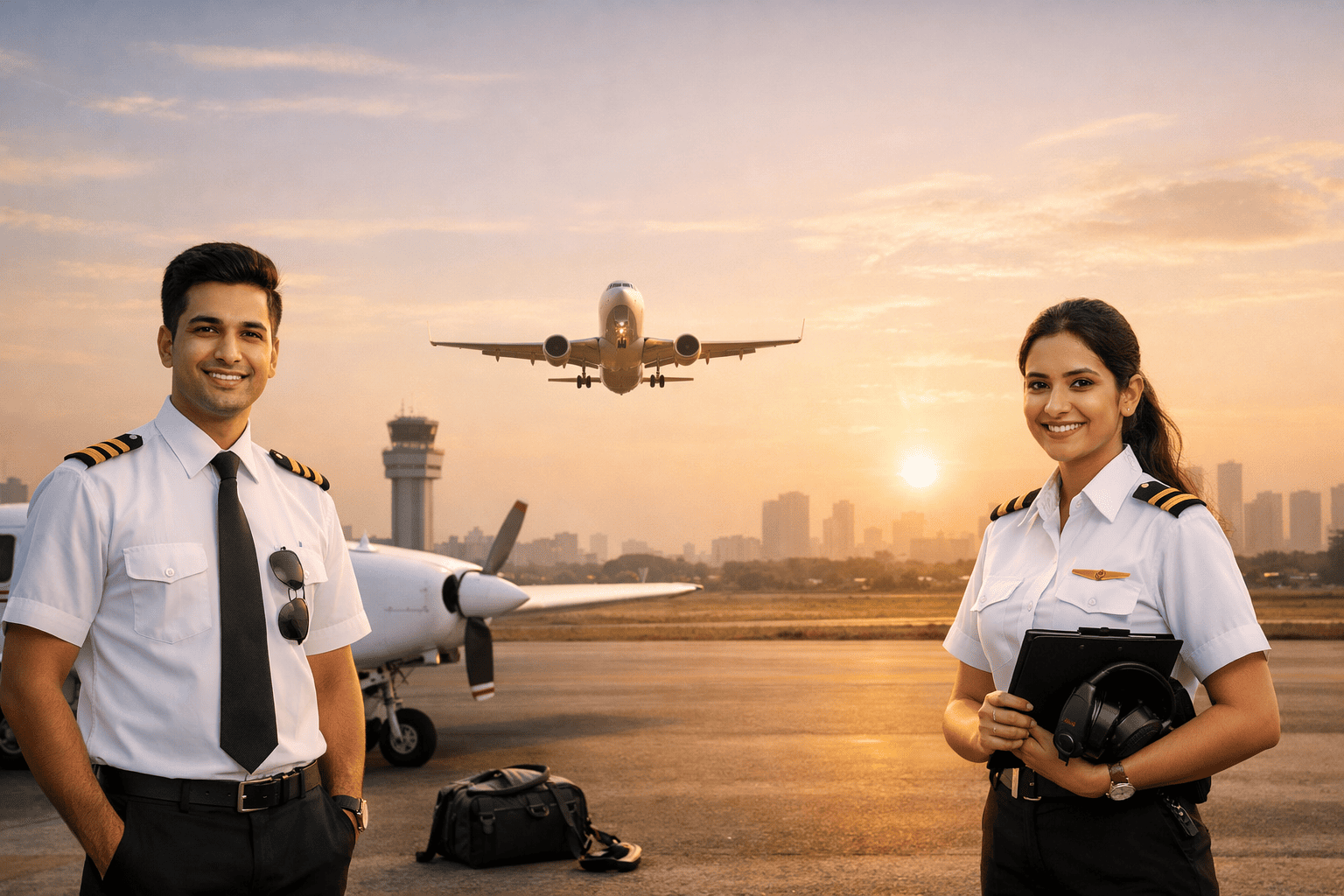
The dream of sitting in the cockpit of a commercial jet is often met with a harsh reality: Let’s be honest: the view from the cockpit is breathtaking, but the price tag to get there can take your breath away for all the wrong reasons. In 2026, the cost of obtaining a Commercial Pilot License (CPL) in India ranges anywhere from ₹50 lakhs to ₹80 lakhs. For many middle-class families, this feels like an impossible hurdle.
However, with the Indian aviation sector booming and airlines placing record-breaking aircraft orders, the demand for pilots has never been higher. To meet this demand, several pilot training scholarships in India have emerged to bridge the financial gap. Whether you are a student from a reserved category, a brilliant academic performer, or a state-level resident, there is likely a pilot scholarship India 2026 program designed for you.
In this guide, we will break down the latest scholarship schemes, eligibility rules, and how you can manage the massive cost of flight training without drowning in debt.
The Cost Reality: Why You Need a Pilot Scholarship in India 2026
Before we dive into the “how,” we must understand the “how much.” Becoming a pilot is not just about flying; it’s a multi-stage financial commitment.
The Breakdown of CPL Costs
- Ground School: Most students begin at a reputed aviation training academy to handle their DGCA ground classes. This phase covers subjects like Air Navigation, Meteorology, and Air Regulations.
- Flight Training: You need 200 hours of flying. In India, this costs roughly ₹45–₹55 lakhs.
- Type Rating: After getting your CPL, you still need an Airbus A320 type rating course or a Boeing 737 equivalent to join an airline. This adds another ₹15–₹25 lakhs to your bill.
Practical Example: The “Hidden” Costs
Imagine you’ve cleared your CPL exam preparation and are ready to fly. You still have to account for DGCA medicals (Class 1 and Class 2), travel, and license processing fees. These small expenses can easily total ₹2–₹3 lakhs over two years. This is why a CPL scholarship in India is so vital—it doesn’t just pay for fuel; it pays for your peace of mind.
Top Pilot Training Scholarships in India (Government & Private)
In 2026, both the central and state governments will have scaled up their support for aspiring aviators. Here are the most prominent aviation scholarships India currently available:
National Overseas Scholarship (NOS)
This is a flagship program by the Ministry of Social Justice and Empowerment. It is specifically for students from SC, Denotified Nomadic Tribes, and semi-nomadic tribes.
- What it covers: It is one of the few scholarships that cover the entire cost of training abroad.
- Income Limit: Usually, the family income must be below ₹8 lakhs per annum.
State-Specific Pilot Scholarships (Bihar, Telangana, Karnataka)
Several state governments provide massive subsidies. For instance:
- Bihar: The Bihar Government has historically provided nearly 100% funding for SC/ST students to undergo pilot training.
- Telangana/Andhra Pradesh: Through the Ambedkar Overseas Vidya Nidhi, students can get up to ₹20 lakhs for pilot training.
- Karnataka: The Prabuddha scheme offers financial assistance for overseas pilot training for marginalised communities.
Private Academy & Airline Scholarships
Some top-tier aviation training academies offer merit-based waivers. If you rank in the top 1% of their entrance exams, they might waive 20–50% of your DGCA Ground Classes or flight fees. Airlines like IndiGo and Air India occasionally offer “deferred payment” models through their Cadet Pilot Programs, though these are technically corporate sponsorships rather than traditional scholarships.
Eligibility Criteria: Who Can Apply for a CPL Scholarship?
Getting a pilot scholarship in India 2026 is competitive. You aren’t just competing for money; you are competing for a seat in a high-demand industry.
Academic Requirements
To be eligible for most aviation scholarships in India, you must:
- Have completed 10+2 with Physics and Mathematics.
- Maintain an aggregate of at least 60% (though scholarship winners usually have 80%+).
- Commerce or Arts students can apply only if they have cleared Physics and Maths through NIOS.
The DGCA Milestone
No scholarship will be granted to someone who hasn’t proven their intent. Most schemes require you to have:
- A valid DGCA Computer Number.
- Clearance of at least two or three DGCA ground classes exams.
- A “Fit” Class 1 Medical Certificate.
Also Read: How to Become a Pilot in India After 12th Commerce or Arts: The 2026 Step-by-Step Guide
Comparison Table: Scholarship vs. Education Loan
| Feature | Pilot Training Scholarship | Pilot Education Loan |
| Repayment | No repayment required | Must be repaid with interest |
| Basis | Merit or Category-based | Collateral or Income-based |
| Coverage | Often partial (20% to 100%) | Up to 100% of training cost |
| Risk | Low (Competitive to get) | High (Monthly EMIs start later) |
| Best For | EWS/Merit students | Students with assets/collateral |
Step-by-Step Process: How to Become a Pilot in India Scholarship Guide
If you are starting from zero in 2026, follow this roadmap to maximise your chances of getting a how to become a pilot in India scholarship.
Step 1: Secure Your Medicals
Don’t spend a rupee on training until you know you are medically fit. Get your Class 2 and Class 1 medicals done. Scholarship boards will ask for these as proof of eligibility.
Step 2: Join a Reputed Academy for Ground Prep
Enrol in DGCA ground classes. Clearing your papers on the first attempt makes you a high-value candidate for merit-based scholarships. Your CPL exam preparation should be your top priority during the first 6 months.
Step 3: Apply for the Computer Number
Register on the eGCA portal and get your computer number. This is your “identity” as a pilot in India.
Step 4: Research and Document
Gather your income certificates, caste certificates (if applicable), and 10th/12th mark sheets. Most pilot training scholarships in India open for applications between January and March for the upcoming flying season.
Financing the Remainder: Loans and Conversion Considerations
If you don’t qualify for a 100% scholarship, don’t lose heart. Most pilots in India use a combination of a partial pilot scholarship India 2026 and a specialised education loan.
Education Loans for Pilots
Banks like SBI (Scholar Loan), HDFC (Credila), and Bank of Baroda offer aviation-specific loans.
- Collateral: You will likely need to provide property as collateral for loans above ₹7.5 lakhs.
- Moratorium: Most banks give you a “grace period” (the duration of your training plus 6-12 months) before you start paying EMIs.
Conversion Considerations
Many students fly in the USA or South Africa because it is faster. However, if you are relying on a government CPL scholarship in India, ensure the scheme allows for overseas training. If it’s a domestic-only scholarship, you must fly at an Indian FTO (Flying Training Organisation). If you fly abroad, you will still need to clear “Conversion Exams” in India, which requires further CPL exam preparation.
Aspirants Point: Final Tips for 2026 Candidates
The “Aspirants Point” is a reality check. In 2026, airlines are looking for more than just 200 hours of flying. They want “Type Rated” pilots. Even if you get a scholarship for your CPL, you must plan for the Airbus A320 type rating course.
- Pro Tip: Look for scholarships that include Type Rating or “Job Assured” programs.
- Networking: Join forums and groups of previous scholarship winners. Organisations like VFTI and Wingpath often post updates on state-level scholarship notifications that aren’t widely advertised.
Conclusion: Your Next Steps
Becoming a pilot is a marathon, not a sprint. While the flight training in India costs a lot, the financial landscape in 2026 is more supportive than ever. A pilot training scholarship in India can be the wings that lift you toward your dream, but only if you put in the hard work on the ground first.
Your Next Steps:
- Check Your Eligibility: Do you fall under any state or category-based scholarship criteria?
- Start Ground School: Enroll in dgca ground classes immediately. You cannot apply for most scholarships without a Computer Number and clear papers.
- Prepare for Exams: Focus on your CPL exam preparation to build a merit-based profile.
- Stay Updated: Follow official government portals and reputable aviation training academies for notification dates.
FAQ
Q: Can I get a 100% scholarship for pilot training in India?
A: Yes, but it is primarily restricted to SC/ST/OBC categories through the National Overseas Scholarship or specific state schemes like those in Bihar and Telangana. General category students usually rely on merit-based partial scholarships from private academies.
Q: What is the maximum age to apply for a pilot scholarship?
A: Most scholarships require you to be between 17 and 25 years old at the time of application.
Q: Is there any scholarship for female pilots in India?
A: Yes. Organisations like “Women in Aviation International” (India Chapter) and certain state schemes offer dedicated financial aid to female aspirants to encourage gender diversity in the cockpit.
Q: Does the scholarship cover the Airbus A320 type rating course?
A: Most government scholarships cover only the CPL (200 hours). However, some advanced state schemes and airline cadet programs include the type rating in their financial structure.
Q: How much does it cost to become a pilot in India in 2026?
A: On average, the total cost—from your first DGCA ground classes to your final Airbus A320 type rating course—ranges between ₹75 Lakh and ₹1.1 Crore.
Q: Can I get a scholarship for the Air India or IndiGo Cadet Program?
A: These airlines do not typically offer “scholarships.” However, they provide the necessary documentation to help you secure a 100% bank loan, which you repay once you start earning as a First Officer.
Q: Is there an age limit for pilot scholarships?
A: Yes, most scholarship schemes have an age limit between 18 and 28 years.