
Currently Empty: ₹0.00

You’ve cleared your DGCA ground exams, your medicals are in order, and you can practically smell the jet fuel. But then, you hit the “Digital Gatekeeper”: the Symbiotics ADAPT Test. If the thought of multitasking on a computer screen while solving math problems makes your palms sweaty, don’t worry—you’re in the right place. The best way to prepare for the ADAPT assessment is to follow a structured 30-day plan that balances mental math drills, hand-eye coordination with a joystick, and a deep dive into the pilot personality profile. It isn’t just about being a “gamer”; it’s about demonstrating cognitive capacity and emotional stability under pressure.
In the modern aviation landscape, the ADAPT assessment has become the primary filter for cadet programs and airline hiring globally. Whether you are aiming for IndiGo, Air India, or a top-tier aviation training academy, this test is your first real “flight” in the eyes of the recruiters. Let’s break down exactly how to move from a beginner to a high-scoring candidate.
What is the ADAPT Test in Aviation?
Before you start clicking buttons, you need to understand the “Why” behind the “What.” So, what is an Adapt test in aviation? Essentially, it is a suite of computerised pilot aptitude assessments designed to predict your future success in flight training.
Unlike a school exam that tests what you have memorised, the pilot aptitude test evaluates your raw potential. It checks if your brain can handle the “overload” of a cockpit environment—monitoring instruments, talking to ATC, and flying the plane—all at the same time.
The Role of Symbiotics
The Symbiotics ADAPT Test is the gold standard of these assessments. It is used by major flight schools and airlines to measure:
- Physical Coordination: Can you keep a crosshair centred?
- Cognitive Ability: Can you solve math and logic problems while distracted?
- Psychological Fit: Do you have the “Captain’s Temperament”?
Why Every Beginner Needs an ADAPT Test Preparation Strategy
Many candidates make the mistake of thinking, “I’m good at video games, I’ll be fine.” This is the fastest way to fail. The ADAPT Test for pilots is designed to push you until you reach your breaking point. The system wants to see how you react when you can no longer keep up. Do you panic, or do you prioritise?
The Cognitive “Battery”
Your brain has a limited amount of “RAM.” When you start the ADAPT Test aviation modules, you use a little bit of that RAM for the joystick. Then, the system adds math problems. Then, auditory signals. A good ADAPT assessment test preparation plan expands your mental “RAM” so you can handle more tasks before your performance drops.
Breaking Down the Core Modules
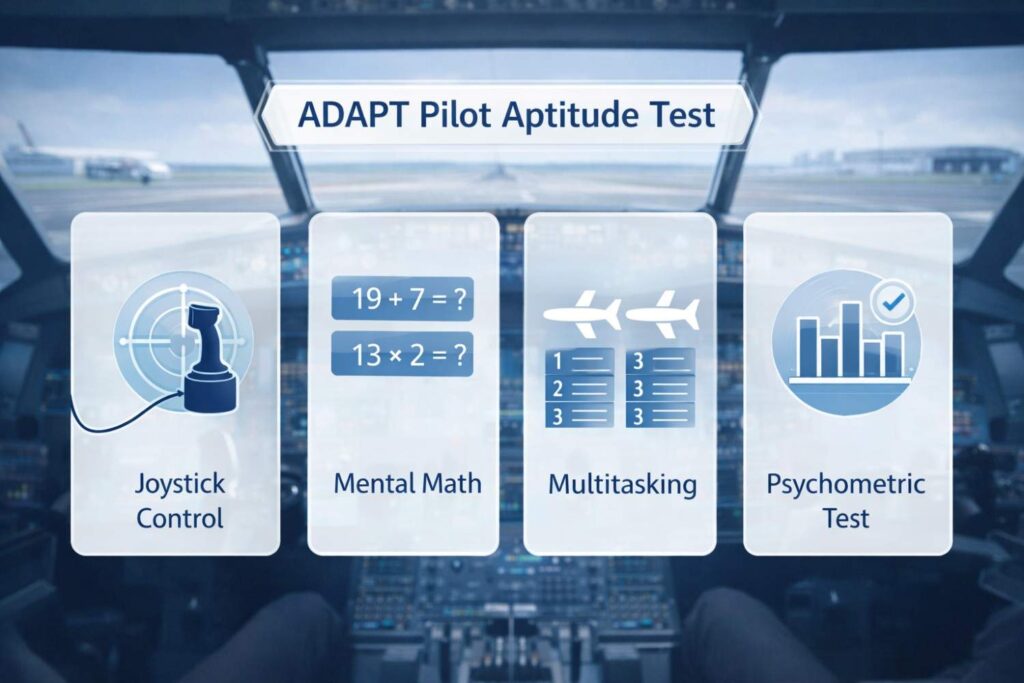
To prepare effectively, you must master the four main “pillars” of the ADAPT assessment test online.
1. The FAST (Future Aptitude Selection Tool)
This is the most famous module. You will use a joystick and a keyboard to track a target while answering math questions and monitoring audio cues. It is the ultimate test of multitasking.
- Pro Tip: Focus 70% of your attention on the primary task (tracking) and 30% on the secondary tasks (math/audio).
2. Applied Numeracy (Mental Math)
You will face questions on speed, distance, time, and fuel.
- Example: If you are flying at 180 knots and need to cover 45 nautical miles, how long will it take?
- The Formula: Time = Distance ÷ Speed Calculation: 45 ÷ 180 = 0.25 hours = 15 minutes
3. Spatial Awareness and Logic
You might see 2D shapes that you need to fold into 3D cubes in your mind. This measures your ability to visualise the aircraft’s position in 3D space.
4. The Adapt Psychometric Test
Often called the APQ (Aviation Personality Questionnaire), this module asks over 100 questions about your behaviour.
- What they want: Consistency. If you say you are “never late” in question 5, but say you “occasionally lose track of time” in question 80, the system flags you as unreliable.
Step-by-Step Preparation Plan for Beginners
If you are a beginner, the ADAPT assessment test online world can feel overwhelming. Follow this 4-week roadmap to build your skills.
Step 1: The Baseline Assessment (Days 1–3)
Don’t start by studying. Start by doing. Take an initial ADAPT test online mock to see where you stand. Are you a math genius but terrible with the joystick? Or do you have great coordination but struggle with spatial reasoning? Your baseline tells you where to focus your energy.
Step 2: Mental Math Mastery (Week 1)
In the real pilot aptitude test, you won’t have time to use a pen and paper.
- The Drill: Practice 2-digit multiplication and division daily.
- The Trick: Learn to “round off” numbers to find the closest answer quickly.
- Practical Example: If the question asks for 49 × 11, think 50 × 11 − 11 = 550 − 11 = 539.
Step 3: Coordination and “The Joystick” (Week 2)
You cannot pass the FAST module using a mouse or a laptop trackpad.
- Invest: Buy a basic flight simulation joystick.
- The Drill: Play simple coordination games while listening to a podcast. Try to summarise what the podcast said while maintaining a high score in the game. This mimics the “auditory monitoring” part of the test.
Step 4: Psychometric Alignment (Week 3)
During the ADAPT psychometric test, the system will ask you the same question in four different ways to see if you’re “faking” it.
- The Strategy: Understand the “Captain’s Profile.” Pilots are supposed to be stable, compliant with rules, and calm under pressure. Reflect on your own life experiences that prove you have these traits.
Step 5: Full Simulation (Week 4)
This is the “polish” phase. Take full-length mock tests that replicate the timing and pressure of the real exam. Focus on your “recovery”—if you make a mistake in one module, don’t let it ruin the next one.
ADAPT Assessment Test Preparation: Comparison of Practice Methods
| Feature | Self-Study (Free) | Online Preparation Platforms | Aviation Training Academy |
| Cost | Low | Moderate | High |
| Realism | Low | High (Software-based) | Very High (Proctor-led) |
| Feedback | None | Automated Scores | Expert Mentorship |
| Joystick Access | No | Requires Purchase | Provided |
| Success Rate | Variable | High | Highest |
Practical Tips and Best Practices
- The Recovery Rule: If you mess up a math question, forget it immediately. If you dwell on a mistake, your joystick tracking will suffer, and you’ll fail two modules instead of one.
- Physical Fitness: It sounds strange, but being well-rested and hydrated significantly improves your reaction time. Avoid heavy caffeine right before the adapt aviation test—it can make your hands shaky.
- Instructions are Key: Many students fail because they rush through the instructions. Sometimes the “rules” of the game change halfway through. Read everything twice.
- The “Centre” Rule: In tracking tasks, always return the joystick to the neutral centre. Over-controlling is the #1 reason for low coordination scores.
Conversion-Focused Section: Taking the Next Step
Preparation is the difference between a “Pass” and a “Try Again in 6 Months.” While self-study is great, the most successful candidates use professional tools.
If you are serious about your career, consider:
- Buying a High-Quality Joystick: A stiff or laggy joystick will ruin your score.
- Subscribing to a Prep Platform: Software like SkyTest or LatestPilotJobs mimics the exact interface of the Symbiotics ADAPT Test.
- Finding a Mentor: Ask a senior at your aviation training academy to sit behind you while you practice and “distract” you with questions. It’s the best way to simulate real stress.
Conclusion: Focus on the Mission
Preparing for the ADAPT assessment test is your first real lesson in being a pilot: it’s all about preparation, staying calm when things go wrong, and managing your resources. Don’t look at it as a hurdle; look at it as your first simulator session.
Next Steps for You:
- Today: Look up what the ADAPT Test sees in the interface.
- Tomorrow: Start your 15-minute daily mental math routine.
- This Week: Get your joystick and begin coordination drills.
FAQ Section
Q: How long does the ADAPT test take?
A: The full test usually lasts between 2 to 4 hours, depending on the airline and selected modules. The FAST module typically takes about 15–20 minutes of intense focus.
Q: Can I retake the ADAPT aviation test?
A: It depends on the airline. Most have a strict waiting period, usually between 3 and 6 months, and sometimes up to 1 year. This makes first-time preparation very important.
Q: Do I need to be a math genius?
A: No. You need to be quick with basic math. The challenge is speed, not complexity.
Q: Is the test different for every airline?
A: The core modules (Math, FAST, Personality) are generally the same, but some airlines may include additional sections like physics or English tests.
Q: What is a “good” Stanine score?
A: Most airlines look for a Stanine score of 6 or higher (on a scale of 1–9). Competitive programs may require 7 or 8.
Q: How hard is the ADAPT test?
A: It is designed to feel overwhelming. Many candidates feel they performed poorly, but this is intentional—it measures your maximum performance capacity.
Q: Do I need to know how to fly a plane to pass?
A: No. The test measures aptitude, not prior aviation knowledge. A pilot license is not required.
Q: Is there a pass mark for the psychometric test?
A: No. There is no pass/fail. Instead, you receive a profile fit rating such as Low, Moderate, or High.