Currently Empty: ₹0.00
DGCA Exam Syllabus 2026: Subject-Wise Guide for CPL Aspirants to Clear Exams in First Attempt
April 17, 2026

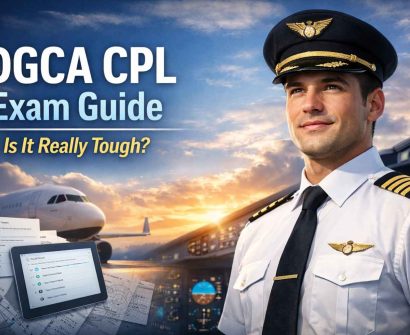
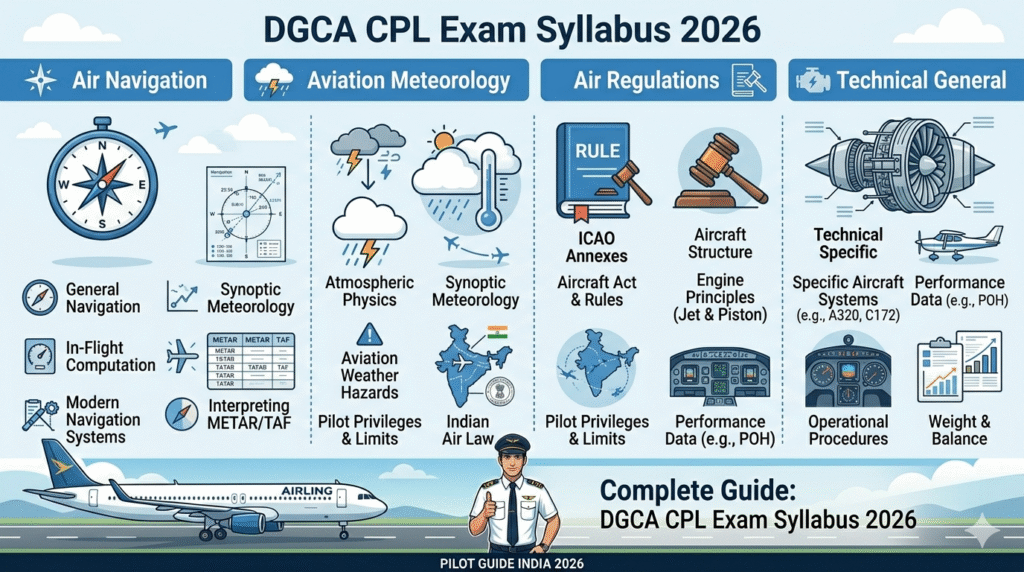
To clear the DGCA Exam Syllabus 2026 on your first attempt, you must master five core theory subjects: Air Navigation, Aviation Meteorology, Air Regulations, Technical General, and Technical Specific, along with the RTR (Aero) communication exam. The Directorate General of Civil Aviation (DGCA) requires a minimum passing score of 70% for each paper. In 2026, the exams have moved toward a more scenario-based approach, making conceptual clarity more important than ever.
Understanding the DGCA CPL Exam Landscape in 2026
The journey to the cockpit of a commercial jet begins long before you touch the controls of a trainer aircraft. It starts with the “Ground Classes”—the academic foundation where you prove you have the mental discipline to handle the responsibilities of a pilot.
Whether you are looking for a top-tier aviation training academy or planning to self-study, understanding the complete DGCA CPL exam preparation syllabus 2026 for beginners is your first real “pre-flight check.”
Why 2026 is Different
The DGCA has updated its question banks to align with international EASA standards. This means rote learning of old question banks won’t cut it anymore. You need to understand why a weather front forms or how a hydraulic failure affects your landing distance.
Subject-Wise Breakdown: What You Need to Study
1. Air Navigation
Often considered the “boss level” of DGCA exams, Air Navigation is heavily mathematical. You will use tools like the CRP-5 (flight computer) to calculate wind drift, fuel burn, and time of arrival.
- Key Topics: Earth magnetism, Latitude/Longitude, Solar time, Chart projections (Lambert’s/Mercator), and Radio Navigation aids (VOR, NDB, ILS).
- Practical Tip: Practice mental math daily. In the exam, you won’t have time to second-guess basic multiplication while solving complex 1-in-60 rule problems.
2. Aviation Meteorology
This subject is all about the “Science of the Skies.” You’ll learn to read the atmosphere like a book.
- Key Topics: High and Low-pressure systems, Cloud formations, Jet streams, and the Indian Monsoon.
- Critical Skill: You must be able to decode METAR and TAF (weather reports) instantly. A single misinterpreted digit could mean flying into a thunderstorm.
3. Air Regulations
Think of this as the “Law of the Air.” It covers the rules you must follow to keep the skies safe and orderly.
- Key Topics: Aircraft Rules 1937, ICAO Annexes, Right-of-way rules, and Aerodrome markings.
- Aviation Training Academy Insight: Most students fail here because they find the legal language dry. Use flashcards to remember specific “CAR” (Civil Aviation Requirements) sections.
4. Technical General & Specific
Technical General covers how aircraft fly (Aerodynamics) and how engines work. Technical Specific focuses on the exact aircraft you will fly, such as a Cessna 172 or Diamond DA42.
- Technical General: Piston/Turbine engines, Airframes, and Electrical systems.
- Technical Specific: V-speeds, Emergency procedures, and Fuel systems of your training plane.
5. RTR (Aero) – Radio Telephony
Conducted by the WPC/DGCA, this is a two-part exam (Practical & Viva) that tests your ability to talk to Air Traffic Control (ATC).
DGCA CPL Exam Pattern at a Glance (2026)
| Subject | No. of Questions | Duration | Pass Mark | Difficulty Level |
| Air Navigation | 100 MCQs | 3 Hours | 70% | High |
| Aviation Meteorology | 50 MCQs | 2 Hours | 70% | Medium |
| Air Regulations | 50 MCQs | 2 Hours | 70% | Medium |
| Technical General | 100 MCQs | 3 Hours | 70% | High |
| Technical Specific | 50 MCQs | 1.5 Hours | 70% | Low-Medium |
| RTR (Aero) | Oral/Practical | – | 50% | Medium-High |
How to Clear DGCA Exams in the First Attempt: A Step-by-Step Guide
Step 1: Secure Your Computer Number
Before you can sit for any exam, you must apply for a Computer Number via the eGCA portal. This is your permanent ID with the DGCA. Start this 3–4 months in advance, as verification can take time.
Step 2: Enroll in Quality DGCA Ground Classes
While self-study is possible, joining professional DGCA ground classes provides you with structured notes, expert shortcuts for Navigation, and regular mock tests. Academies like the Aviation Training Academy offer specialised modules that simplify complex Boeing or Airbus systems even at the CPL level.
Step 3: Master the Tools
Buy a CRP-5 Flight Computer and a scientific calculator early. You should be able to operate them with your eyes closed. Navigation is 40% knowing the theory and 60% being fast with your tools.
Step 4: The “Mock Test” Phase
In the final 3 weeks before the exam, solve at least one full-length mock paper every day. This builds the “exam stamina” needed to sit for 3 hours without losing focus.
Best Practices for 2026 Aspirants
- Don’t Skip Technical General: Many students focus so much on Navigation that they ignore Technical General. Remember, you need to understand the electrical system of a plane before you can dream of an Airbus A320 type rating course.
- Stay Updated on CARs: The DGCA frequently updates Civil Aviation Requirements. Ensure your study material is the 2026 edition.
- Focus on Concepts: If you understand why the aircraft stalls, you can answer any question about stall speeds, regardless of how it’s phrased.
Ready to Start Your Aviation Career?
The DGCA Exam Syllabus 2026 is the gateway to your wings. At the aviation training academy, we don’t just help you pass exams; we build pilots. Our DGCA ground classes are designed to take you from a beginner to a confident CPL holder, ready for your Airbus A320 type rating course and beyond.
[Contact our Admissions Team today to enroll in our next batch!]
Conclusion
Clearing the DGCA Exam Syllabus 2026 is a marathon, not a sprint. By breaking down the subjects, starting early with your Computer Number, and choosing a reputable aviation training academy, you set yourself up for success. Remember, every senior Captain once sat where you are now—staring at a Navigation chart and wondering if they’d ever get it. Stay consistent, stay disciplined, and the sky will be yours.
FAQ:
Q. Is there negative marking in DGCA CPL exams?
A. No, there is currently no negative marking in DGCA theory exams. However, the 70% passing threshold is strictly enforced.
Q. How many times a year are the DGCA exams conducted?
A. Regular sessions are typically held four times a year (usually March, June, September, and December). There are also “On-Demand” sessions (OLODE) held almost every month.
Q. Can I apply for exams without a 10+2 Physics/Math background?
A. No. You must have passed 10+2 with Physics and Mathematics. If you didn’t, you can clear these subjects through the National Institute of Open Schooling (NIOS) before applying.
Q. What is the validity of a passed DGCA paper?
A. A passed theory paper is valid for five years. You must complete your flying training and apply for your license within this window.
Q. Which is the hardest subject in the DGCA CPL syllabus?
A. Most students find Air Navigation and Technical General the most challenging due to the heavy syllabus and numerical problems.
Q. Do I need to clear RTR (Aero) before starting flight training?
A. No, but it is highly recommended. Having your RTR and theory papers cleared allows you to focus 100% on your flying hours without the stress of exams.
Q. How many subjects are there in DGCA CPL exams?
A. There are 5 technical subjects (Nav, Met, Regs, Tech Gen, Tech Spec) plus the RTR(A) exam for radio communication.
Q. What is the pass mark for DGCA exams?
A. You need at least 70% to pass each subject.
Q. Can I clear these exams without a science background?
A. You must have Physics and Maths at the 10+2 level. If you didn’t have them, you can clear them via NIOS first.
Q. How long are DGCA exam results valid?
A. Once passed, your results are usually valid for 5 years to apply for your license.
Q. Is there negative marking in DGCA exams?
A. No, there is currently no negative marking, but the questions are designed to be tricky.