
Currently Empty: ₹0.00
Is DGCA CPL Exam Tough? Difficulty Level Explained for Each Subject How to Clear (2026 Edition)
April 16, 2026
If you are planning to become a commercial pilot in India, the first major step is clearing the DGCA CPL (Commercial Pilot License) ground examinations.
A common question is: “Is the DGCA CPL exam tough?”
The answer is: Yes, it is challenging—but completely achievable with the right preparation.
DGCA exams are different from school or college tests. They don’t focus on memorisation; instead, they test your conceptual understanding, accuracy, and ability to apply knowledge in real aviation scenarios.
With a minimum passing mark of 70%, the exams are designed to ensure strong aviation fundamentals rather than rote learning. In recent years, the difficulty has shifted more toward concept-based questions, making preparation more important than ever.
With structured study, guidance from a good aviation training academy, and DGCA ground classes, students clear these exams every year and progress toward their pilot career.
Why DGCA CPL Exams Feel Difficult
The DGCA Commercial Pilot License (CPL) exams are the gatekeepers of the Indian cockpit. In the 2026 edition of these exams, we’ve seen a significant increase in “scenario-based questions.” The examiners are no longer satisfied with you knowing the definition of a stall; they want to know how you’d react to a stall in a specific weather pattern over the Himalayas.
DGCA exams are not difficult because the syllabus is impossible. They are challenging because of:
- Concept-based and application-driven questions
- High accuracy requirement (small mistakes change answers)
- Time pressure during calculations
- Multiple subjects requiring consistent preparation
- Overlap with flying training in some cases
Why the Difficulty Level Feels High
The pressure comes from three factors:
- The 70% Cut-off: There is no “grace mark.” You either know your stuff, or you don’t.
- Negative Marking (Psychological): While there isn’t literal negative marking yet, the complexity of options (where three answers look correct) acts as a psychological trap.
- The Syllabus Breadth: You are expected to be a mathematician, a meteorologist, and a lawyer all at once.
Many students underestimate the exams initially, thinking they are similar to academic theory. This mindset often leads to failure in early attempts.
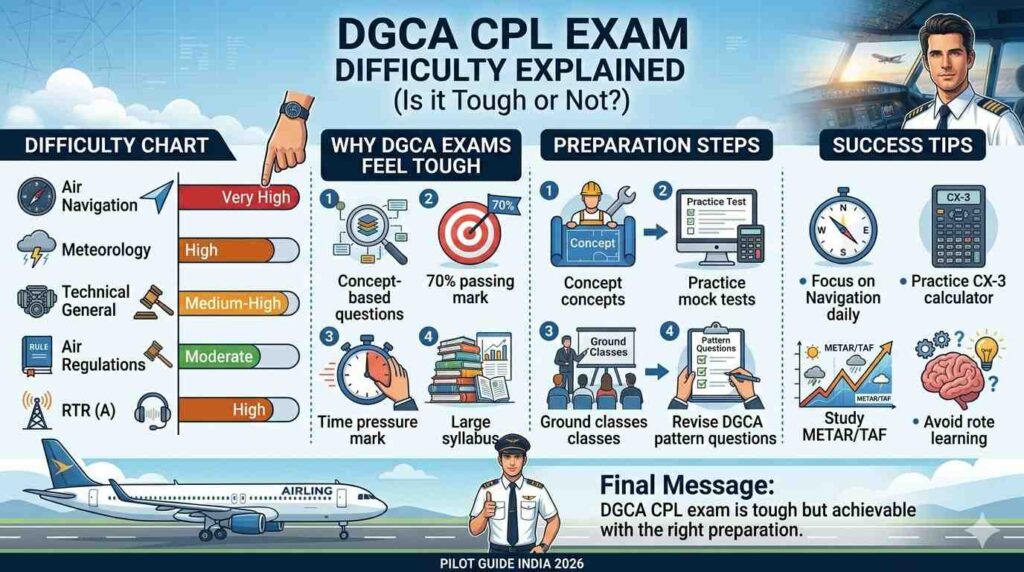
DGCA CPL Subject-Wise Difficulty (2026 Analysis)
To understand the real challenge level, let’s break down each subject.
1. Air Navigation (Difficulty: Very High)
Air Navigation is widely considered the most challenging DGCA CPL subject.
It involves:
- Time, speed, and distance calculations
- Wind triangle problems
- Flight planning and fuel calculations
- Use of navigation charts and flight computers
The difficulty lies in precision under time pressure. Even a small calculation or interpretation mistake can lead to a wrong answer.
What it covers: Flight planning, Jeppesen charts, radio aids, and instrumentation.
Why it’s tough: This is the most feared subject. It involves heavy mathematical calculations using the CX-3 flight computer. In 2026, the DGCA increased the number of “General Navigation” questions involving complex time-zone and polar navigation logic.
Clearance Strategy: Don’t just memorise formulas. Understand the logic of the triangle of velocities. Use an aviation training academy for structured coaching if you find yourself struggling with chart work.
Students who practice regularly with structured problem-solving techniques find this subject manageable over time.
This is also the subject where most students benefit from structured DGCA ground classes, especially when learning navigation techniques from scratch.
2. Aviation Meteorology (Difficulty: High)
Meteorology focuses on understanding weather systems and their impact on aviation.
Key topics include:
- Clouds, turbulence, and icing
- Thunderstorms and monsoon systems
- METAR and TAF interpretation
- Indian weather patterns
The real challenge is not theory—it is interpreting weather data in operational scenarios.
What it covers: Atmosphere, pressure, wind, clouds, and METAR/SPECI decoding.
Why it’s tough: The weather is unpredictable, and so are the questions. You need to interpret synoptic charts and understand how a western disturbance in North India affects flight visibility.
Clearance Strategy: Focus on the “Indian Climatology” section. It’s high-scoring and very relevant for pilot license exams in
India.
Students who connect meteorology with real flying conditions find it easier to understand and remember.
3. Technical General (Difficulty: Moderate to High)
Technical General builds the foundation of aircraft knowledge.
It includes:
- Aircraft systems (hydraulic, electrical, fuel)
- Engines (piston and turbine basics)
- Instruments and performance concepts
The common mistake students make is memorising instead of understanding systems.
- What it covers: Engine systems, hydraulics, electricity, and specific aircraft types (like Cessna 172 or Diamond DA42).
- Why it’s tough: You need to understand the “heart” of the machine. The specific paper is mandatory for whichever aircraft you plan to fly during training.
- Clearance Strategy: Use 3D diagrams. Seeing how a four-stroke engine works is much easier than reading about it in a 500-page manual.
DGCA often tests conceptual clarity, so understanding “how and why” is more important than rote learning.
This subject becomes extremely valuable later during your Airbus A320 type rating course, where systems knowledge is applied in simulators.
4. Air Regulations (Difficulty: Moderate)
Air Regulations deal with aviation laws and operational rules.
It includes:
- Aircraft Act and CARs
- Licensing requirements
- Operational rules and limitations
While it may appear simple, DGCA questions are often word-sensitive and scenario-based, meaning a small change in wording can change the correct answer.
What it covers: Aircraft Rules 1937, ICAO Annexes, Air Traffic Services, and Search & Rescue.
Why it’s tough: It is dry. It involves memorising thousands of rules, lights, and signals. One wrong number (e.g., 5 miles vs. 5 kilometres) and you lose the mark.
Clearance Strategy: Treat it like a story. Relate the rules to actual flight scenarios.
Students who understand the logic behind regulations perform much better than those who simply memorise rules.
Read More: Understanding DGCA Class 1 and Class 2 Medical Certificates: Complete Guide for Pilots
DGCA CPL Exam Difficulty Summary Table
| Subject | Difficulty | Main Challenge | Best Preparation Approach |
|---|---|---|---|
| Air Navigation | Very High | Numerical accuracy & speed | Daily practice with problem sets |
| Meteorology | High | Weather interpretation | Study charts & real scenarios |
| Technical General | High | System understanding | Learn diagrams & concepts |
| Air Regulations | Moderate | Legal wording precision | CAR-based reading |
| RTR (A) | High | Speaking confidence | Mock RT practice sessions |
How to Clear DGCA CPL Exams Successfully
Clearing DGCA exams requires discipline and a structured approach rather than random studying.
1. Build Strong Concepts First
Avoid memorising answers. Focus on understanding how aviation systems, weather, and navigation actually work.
2. Practice DGCA Pattern Questions Regularly
The exam is computer-based and follows a specific pattern. Regular practice helps improve speed and accuracy.
3. Join Structured DGCA Ground Classes
While self-study is possible, subjects like Navigation and Meteorology become significantly easier with guided training.
A good aviation training academy provides:
- Structured syllabus coverage
- Mock tests based on the DGCA pattern
- Doubt-clearing sessions
- Exam-focused strategies
4. Clear Exams Before Flying Training (Recommended)
Most students prefer clearing DGCA theory exams before starting flying training.
This helps because:
- You can focus fully on flying later
- Reduces stress during simulator and flight training
- Speeds up overall CPL completion
Also Read: What Is the Partial Rejection System in DGCA Allotment?
Step-by-Step Guide: How to Clear DGCA CPL Exams 2026
If you want to clear your exams in a single attempt, you cannot “wing it.” You need a professional approach.
- Get Your Computer Number: You can’t sit for exams without it. Apply on the eGCA portal early.
- Master the Concepts: Forget the old “question bank” approach. In 2026, the DGCA is constantly changing questions. Use textbooks like Oxford or Nordian for a solid foundation.
- Join an Aviation Training Academy: If you are a beginner, self-studying for Navigation and Meteorology can be overwhelming. A mentor can simplify complex concepts like “Map Projections.”
- Practice Mock Tests: Time management is key. You usually have 3 hours for 100 questions. Practice under timed conditions to avoid panic on the big day.
- Focus on the “Big Three”: Navigation, Meteorology, and Regulations are your primary hurdles. Clear these first before moving to Technicals.
Best Practices & Practical Tips for Success
- Concepts Over Rote Learning: The 2026 exams are designed to catch people who just “cram.” Understand why an altimeter over-reads in cold air.
- Stay Updated with DGCA Notices: Rules change. AIP (Aeronautical Information Publication) supplements are updated frequently. Ensure your study material reflects the latest DGCA pilot exams India standards.
- Mental Fitness: Preparing for these exams is a marathon. Many students also start looking into the adapt aviation test (psychometric readiness) around this time to prepare for future airline selections.
- The CX-3 Advantage: Become a wizard with your flight computer. It should feel like an extension of your hand during the Navigation exam.
Best Way to Pass DGCA Exams 2026 (The Secret Sauce)
The “best way” isn’t a shortcut; it’s consistency. Spend 4 hours every day, 6 days a week. In the pilot community in India, we say that “The ground is harder than the sky.” Once you clear these papers, the flying part is pure joy.
If you are struggling with a specific subject, don’t keep banging your head against the wall. Seek help from a specialised pilot training centre in India or an online ground school that uses modern 2026 teaching methods.
Is DGCA CPL Exam Hard or Just Different?
DGCA CPL exams are not impossible. They are simply different from traditional academic exams.
They test whether you are developing the mindset of a professional pilot—someone who can think accurately, quickly, and logically under pressure.
With the right strategy, consistency, and mentorship, thousands of students clear these exams every year and move forward toward their Airbus A320 type rating course and airline careers.
5 Practical Tips for Success in 2026
- Concept over Memory: If you understand why a plane stalls, you won’t need to memorise the recovery steps—you’ll just know them.
- Calculator Proficiency: You are allowed specific calculators (like the Casio FX-82MS). Learn every function of it.
- Stay Updated on CARs: The DGCA frequently updates Civil Aviation Requirements. Ensure your DGCA CPL exam preparation for 2026 includes the latest amendments.
- Simulate Exam Pressure: Sit for 3-hour mock tests without any distractions.
- Don’t Overlap Flying & Exams: Ideally, clear at least 3-4 papers before you head to a Flight Training Organisation (FTO). This allows you to focus 100% on the cockpit.
Final Thoughts
DGCA CPL exams may appear tough at first, but they are designed to build strong aviation fundamentals.
If you approach them with discipline, structured preparation, and proper guidance, they become not a barrier, but the first major achievement in your journey to becoming a pilot.
Clearing the DGCA CPL exams is the first real “solo” flight of your career. It tests your discipline, your patience, and your intellect. While the difficulty level is high, remember that thousands of pilots clear these every year by following a structured plan.
Ready to start your journey? Here are your next steps:
- Verify your 10+2 documents and apply for a Computer Number on the eGCA portal.
- Buy the latest edition of Jeppesen or Oxford manuals.
- Find a reputable aviation training academy or ground school in major hubs like Delhi, Mumbai, or Bangalore.
- Start with Air Regulations to build momentum, then tackle the “beast” that is Air Navigation.
FAQ:
Q: Is the DGCA CPL exam harder than the FAA (USA) exams?
A: Yes, generally. While the FAA focuses heavily on practical knowledge and has a lower passing bar (70% vs. 70%, but the DGCA questions are more complex), the DGCA exams are known for their deep theoretical and mathematical rigour.
Q: Can I clear DGCA exams without coaching?
A: It is possible for Regulations and Technicals, but Navigation and Meteorology are significantly easier to clear with professional guidance from an aviation training academy.
Q: How many attempts can I take?
A: There is no limit on attempts, but exams happen every 3–4 months. Failing multiple times can delay your flight training by years.
Q: What is the passing mark?
A: You need to score at least 70 out of 100 to be declared “Pass.”
Q: Do I need a science background?
A: Yes, you must have cleared 10+2 with Physics and Mathematics (or equivalent) to be eligible for a CPL in India.
Q: Is the DGCA CPL exam tough in India?
A: Yes, it is considered one of the most rigorous pilot exams globally due to the 70% passing threshold and a focus on manual navigation skills.
Q: Which subject is the hardest in DGCA CPL?
A: Air Navigation is statistically the hardest subject with the highest failure rate in India.
Q: How long does it take to prepare?
A: A dedicated student typically needs 4 to 6 months of consistent study to be ready for all subjects.
Q: How many attempts are needed?
A: Many students are clear in their first attempt with structured coaching. However, the average is 2 attempts for the tougher subjects like Navigation.