Currently Empty: ₹0.00
How to Crack Airline Pilot Interview in India (2026 Complete Guide for CPL Students)
April 17, 2026
Getting shortlisted for an airline pilot interview India is a major achievement, but clearing it is the real challenge. Most CPL holders fail not because they lack flying knowledge, but because they are not fully prepared for interviews, psychometric tests, and simulator evaluations.
Direct Answer: To crack a pilot interview in India, you need strong DGCA technical knowledge, structured CPL interview preparation, good communication skills, and proper practice for psychometric and simulator assessments.
This guide gives you a complete step-by-step strategy to help you succeed in 2026.
Airline Pilot Selection Process in India (Step-by-Step)
Understanding the airline pilot selection process is very important before starting preparation. Each stage tests a different skill.
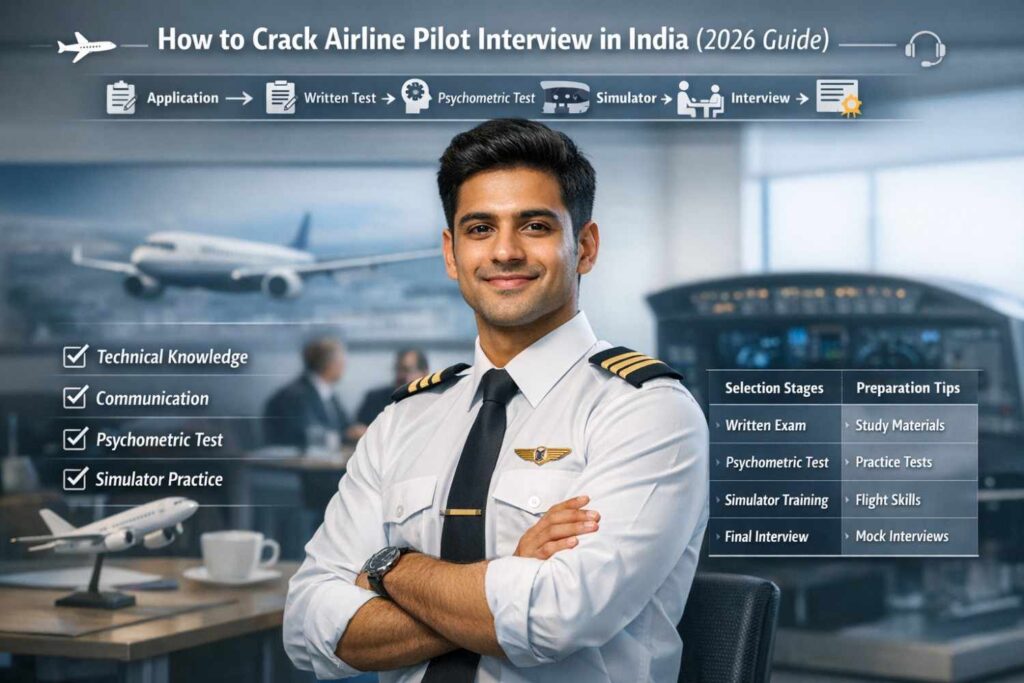
Selection Stages
- Application Screening
- Written Test (Technical + Aptitude)
- Psychometric Test (adapt psychometric test style evaluation)
- Simulator Assessment
- Technical Interview
- HR Interview
Comparison Table (Featured Snippet Ready)
| Stage | What is Tested | Preparation Strategy |
|---|---|---|
| Written Test | Technical + aptitude | DGCA revision + mock tests |
| Psychometric Test | Behavior & decision-making | Practice consistency-based tests |
| Simulator Check | Flying skills + SOP discipline | Simulator training sessions |
| Technical Round | Aviation concepts | Concept clarity |
| HR Round | Communication + attitude | Mock interviews |
Why CPL Students Fail in Pilot Interviews
Even after training from an aviation training academy, many candidates fail due to:
- Lack of conceptual understanding
- Weak communication skills
- No mock interview practice
- Ignoring psychometric preparation
Example:
A candidate may know technical subjects well but fail when asked:
“What will you do if your captain makes a wrong decision?”
Airlines are testing judgment, not memorisation.
Step-by-Step Guide to Crack the Pilot Interview in India
Step 1: Strengthen Technical Knowledge
Focus on core DGCA subjects:
- Meteorology
- Navigation
- Air Regulations
- Technical General
Tip: Try explaining concepts in simple words. If you can explain it clearly, you understand it well.
Step 2: Practice Pilot Interview Questions India
Common pilot interview questions in India include:
- Why do you want to become a pilot?
- Explain lift in simple terms
- What is CRM (Crew Resource Management)?
- Describe a stressful situation you handled
Use the STAR method:
- Situation
- Task
- Action
- Result
Step 3: Prepare for Psychometric Test
Airlines use tools similar to adapt psychometric test formats to evaluate:
- Decision-making ability
- Emotional stability
- Team behavior
Important: There are no right or wrong answers. Consistency is the key.
Example:
“If a colleague breaks SOP, what will you do?”
Correct answer approach: Follow rules and report through proper channels.
Step 4: Simulator Preparation
Simulator assessments test:
- Situational awareness
- Checklist discipline
- Communication skills
Practice scenarios like:
- Engine failure after takeoff
- Bad weather landing
- ATC communication issues
Step 5: HR Interview Preparation
This round evaluates your personality and attitude.
Airlines look for:
- Confidence (not overconfidence)
- Clear communication
- Professional behavior
Better Answer Example:
Instead of saying: “Flying is my passion”
Say: “Flying requires discipline, precision, and continuous learning, which matches my career goals.”
Pilot Interview Tips India (High Impact Tips)
Think Like an Airline
Airlines want:
- Safety-first mindset
- Team players
- Calm decision-makers
Always ask yourself:
“Would I trust myself as a passenger?”
Improve Communication Skills
Communication is a major selection factor.
- Speak English daily
- Record your answers
- Practice with peers
Join Structured CPL Interview Preparation India Training
A good aviation training academy helps with:
- Mock interviews
- Simulator training
- Psychometric preparation
Avoid Common Mistakes
- Overconfidence
- Guessing technical answers
- Poor grooming
- Ignoring HR round
Real Example
A CPL student failed his first airline pilot interview in India attempt due to poor communication.
After 2 months of preparation:
- Improved speaking skills
- Practiced mock interviews
Result: Successfully cleared the interview.
What Airlines Look for in Pilots
Key Traits
- Decision-making ability
- Situational awareness
- Teamwork
- Discipline
How to Show These Traits
- Give real-life examples
- Stay calm under pressure
- Answer logically
Preparation Focus Areas
- Daily DGCA revision (1–2 hours)
- Weekly mock interviews
- Simulator practice
- Personality development
Practical Tips / Aspirant’s Point
- Don’t “Fake” It: Psychometric tests have “lie scales.” If you try to give “perfect” answers, the algorithm will flag you as inconsistent.
- Know Your Aircraft: If you flew a Cessna 172 or Piper Seneca, know its fuel capacity, V-speeds, and emergency procedures like the back of your hand.
- Grooming is Non-Negotiable: Clean-shaven is still the gold standard for interviews in India. Nails should be trimmed, and shoes should be mirror-shined.
Conclusion (Next Steps)
Cracking an airline pilot interview in India is not about luck—it is about structured preparation and consistent practice.
What you should do next:
- Start daily DGCA revision
- Practice pilot interview questions in India
- Prepare for adapt psychometric test
- Join a reliable aviation training academy
- Take regular mock interviews
Your CPL is only the beginning. The real step is clearing the interview and proving you are ready for airline operations.
FAQs
Q. How to crack a pilot interview in India?
A. Focus on technical knowledge, communication skills, and psychometric preparation.
Q2: What are common pilot interview questions?
A. Technical, situational, and personality-based questions.
Q. What is the airline pilot selection process?
A. Written test, psychometric test, simulator check, technical and HR interview.
Q. Best CPL interview preparation method?
A. Mock interviews, simulator practice, and structured training.
Q. Do airlines check personality?
A. Yes, personality and attitude are very important.
Q. Is CPL enough to get a job?
A. No. You must clear the airline selection process.
Q. How long does preparation take?
A. Usually 2–4 months.
Q. Are psychometric tests difficult?
A. Not difficult, but requires practice.
Q: How to crack a pilot interview in one go?
A: Focus on the “Three Pillars”: Technical accuracy, CRM skills (teamwork), and professional grooming. Most candidates fail because they ignore the soft skills.
Q: What is the most common reason for pilot interview rejection?
A: A lack of humility or honesty. If a panel senses you are hiding a flying error or have a “Hero” complex, you will be rejected immediately, regardless of your technical scores.
Q: Is an Airbus A320 type rating mandatory for an interview?
A: For “Conventional CPL” intakes, it’s not. However, having a type rating from a reputable aviation training academy significantly increases your selection chances as you are “line-ready.”
Q: What should I wear for an airline interview in India?
A: A well-tailored navy blue or charcoal grey suit with a crisp white shirt and a conservative tie. You want the panel to visualise you in their airline’s uniform.
Q: Do airlines check my social media?
A: Yes. In 2026, many HR teams perform a basic digital check. Ensure your public profiles reflect a professional and disciplined image.